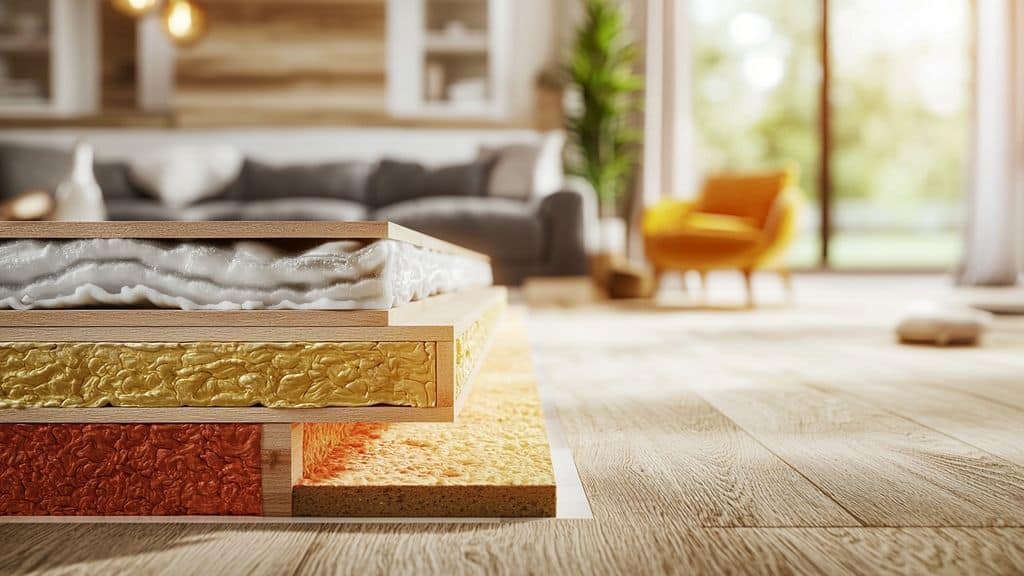
The isolation of the low floors is a key step to improve thermal comfort and reduce energy losses. In an old house or in a renovation, the solutions vary according to the configuration of the accommodation and specific needs. Two main approaches emerge: isolation from above or isolation between beams. The materials chosen must satisfy the criteria of thermal performance, resistance to humidity and adaptability to technical constraints.
Insulation techniques
Superior isolation
This method is to lay insulating panels or an insulating screed on the existing floor. Ideal for stays, avoid invasive work and allows you to add a heated floor. The recommended materials include the Extruse polystyrene (XPS) For the basements, thanks to its resistance to humidity and compression.
Concrete example : In a house in the 1960s with an unheated subsoil, the XPS 8 cm panels reduced heat losses of 15 %, allowing an annual saving of € 150.
Isolation between beams
Suitable for intermediate wooden floors, this technique consists in inserting insulating materials between the beams. There glass wool or the rock wool They are favored for their double thermal and acoustic performance.
Cas of application : In an old apartment, a 12 cm glass wool between the beams reduced the impact noises of 50 % and an improvement in thermal insulation.
Insulating materials: performance and choice
Rock wool and glass wool
These mineral insulators offer a Good value for money -Prezzo and resistance to humidity. Their thermal conductivity varies between 0.033 and 0.044 W/mk, depending on the thickness.
Benefits :
- Versatility : Suitable for low floors, attic or walls.
- Sustainability : resist harmful and fire.
- Moderate cost : Between 4 and 17 €/m² for rock wool.
Confine :
- Settlement : loss of long -term performance.
- Difficult recycling : environmental impact to consider.
Polyurethane projected
Polyurethane stands out for its Exceptional insulating power (R = from 3.1 to 8.05 m².K/WA Second of the thickness). Its application requires a professional, but adapts to irregular surfaces, such as the garage ceilings.
Example : A 6 cm polyurethane foam on a garage ceiling stabilized the temperature of a room above, reducing heating needs.
Disadvantages :
- High cost : about 11-25 €/m² with installation included.
- Risk of condensation : incompatible with permeable materials with water vapor.
Concrete houses: customized solutions
Old house with unheated basement
Problem : Cold floors in winter, loss of heat.
Solution : Installation of 8 cm XPS panels under the floor.
Results : Reduction of 15 % of the losses, saving € 150/year.
Noisy apartment under an inhabited floor
Problem : Impact noises and thermal loss.
Solution : 12 cm glass wool Among the beams.
Results : 50 % reduction of noises, lower heating needs.
Piece above a scarcely isolated garage
Problem : Floating temperatures.
Solution : 6 cm in polyurethane foam On the ceiling of the garage.
Results : Thermal stabilization, reduced energy consumption.
Key factors for successful insulation
Humidity management
Low floors are often exposed to humidity. Materials such as the XPS or the Roccious wool treated They are recommended for their water resistance.
Precautions
- Check the basement hold before work.
- Avoid sensitive materials to humidity (e.g. perlite not treated).
Avoid thermal bridges
The crossings between floors and walls are critical areas. Solutions like Insulating bands or the Thermal switches allow to limit losses.
Example : Maulk with large foam around doors and windows reduces air leaks.
Ventilation and tension
A Controlled mechanical ventilation (VMC) It is essential to avoid condensation. Theair hold It must be treated, especially with specific membranes.
Good practices :
- Put a steam brake Between isolation and coating.
- Keep a lame air For electric networks.
The isolation of the low floors requires a weighted choice between techniques and materials. The solutions vary according to constraints (humidity, noise, budget) and needs (thermal comfort, acoustic). Mineral materials such as rock wool or XPS remain economic options, while polyurethane insulators and biosourcing offer higher performance at a higher cost. A previous study with a professional allows you to define the optimal strategy, integrating additional measures (ventilation, treatment of thermal bridges).
latest posts published
Discover our furniture line in Cotia

Prepare your outdoor space for summer

Safety Tips – Construtora Agmar
Gourmet space in Agmar developments: by Cícera Gontijo

Easter in the condominium: 3 games to play with the children

Sophistication in your company: discover high-end office furniture
Yora Building, the most awaited building in Agmar
Pets in apartments: advice on how to raise them
Five tips for adding rugs to your decor